Be yourself; Everyone else is already taken.
— Oscar Wilde.
This is the first post on my new blog. I’m just getting this new blog going, so stay tuned for more. Subscribe below to get notified when I post new updates.
Be yourself; Everyone else is already taken.
— Oscar Wilde.
This is the first post on my new blog. I’m just getting this new blog going, so stay tuned for more. Subscribe below to get notified when I post new updates.
The field of early childhood education has always been a part of my life. My mother and mother-in-law taught K-3 for over 25 years in Viet Nam. I suppose I am a product of the environment I grew up in. Surrounded by the sounds of the schoolyard, of crayons and glue, I am at home.
A creative at heart, I thought I could do anything to win the heart of children.
For myself, I enjoy working directly with children 3+ years old. I know children love painting and doing some artwork and I know how they introduce art to children. Being an artist, I also find becoming a children’s illustrator very alluring. When I was young, I spent my summers creating bulletin boards, games and backdrops for my mother’s classroom and many of her coworkers. I love to create, and any job that lets me create for or with children is enticing. I have been teaching in Preschool for more than 15 years.
I am 100 percent sure I want to continue in this process in my education to help other students and be a well participate in the education system. A child’s early life is filled with learning opportunities that are important to their future. Patience,creativity, a love for the field and a bachelor’s degree in child development are important elements of being an effective early childhood educator. That’s why I continue to pursue my higher education.
The area that I showed strength in my teaching career is helping children learn by listening to them, answering their questions, and providing a safe and supportive environment for learning. As preschoolers play, they develop skills that help them think, question, and explore the world. I help them learn to interact with others and solve problems in different situations. It is in these settings that children can begin to learn to regulate their emotions and express their feelings. Children learn to solve problems by themselves and with others. These experiences can be very useful when they arrive at school. I also allow them to make their own choice but also help them understanding good choices and bad choices to choose. Besides this, I like to create my lesson plan based on children’s interest and also follow creative curriculum. Building parent-teacher partnership is very important in my teaching career as well.
The areas of growth that I will work more with children to connect new ideas and skills to what they already know and can do. I will help them build knowledge that connect to a child’s interests, such as bugs or airplanes. I will put my full attention to students realizing the work i would need to put into a classroom and it gives me a deeper understanding of what I need to pay attention to in the future working with the students. When teachers build learning experiences on what children know, they provide experiences that children find challenging but can do with a little help. This provides experiences that are “developmentally appropriate,” which are an important part of having early high-quality childhood experiences that lead to positive outcomes.
Going back to the school’s mission statement I think I have been working here for 4 years so I have seen our school promotes school and life readiness by providing multi-cultural early learning services to children and families especially those who need our services the most. We respect and preserve each child and family’s individually, cultural heritage and home language. We also promote personal and social responsibility with integrity and love in an environment defined by social justice and peace. It is full of culture and we put both of education system and integrate it with the schools symbolic which is extremely helpful for the students to see that they are celebrated.
I believe that I need to put them in the same level of learning, it is easy for me to know how to use the new language to compare the two groups then have children repeat the comparison sentence after me. Next, as a group, practice counting each group to determine the total number in the group. Then, have the group practice using comparison vocabulary to describe the groups. After that, the children turn and talk to share which group they think is bigger with a partner. Use the following sentence frame, “I think ____ is bigger because ____.”
2. I chose this book because I notice that in my classroom the children are hurting each other feelings and have not been showing empathy to one another and even they don’t know how to apologize to please others. I have seen many times when a child’s feelings get hurt, but the other child does not seem to care about how the other person was feeling. I wanted to show children that people do have feeling too and we should work together to solve the conflict with our words.
3. Prior to my reading preparation, We have many Dual Language Learners in our classroom and it is good to see many languages in read aloud. There are many children who need more support in emotions and connect them to what we read and explain to them. This book connects to what is happening in the classroom. I have many children who never been in school before so they don’t know how to show their feelings or solve problems with others.
4. I prepare different feelings pictures in different languages. strategies that I use was asking questions, having the children interacting with the book and covering up some of the words so they could read the pictures then revealing the words afterwards. When asking questions, I wanted the children to tell me which child was feeling what. I also wanted the children to teach me Spanish too, so I ask them to tell me how to say, “Happy” in Spanish, Chinese, Vietnamese.. or how to say, “Sad” in Spanish, Chines, Vietnamese… When interacting with the book I wanted the children to show me their faces of the emotions shown in the book. I wanted the children to recognize each other faces when they are feeling something. Lastly I wanted the children to learn the words in English as well, so by covering up the word, then revealing it to them, I was able to create kind of a “guess the emotion game” base on the picture, then the word would be revealed. I also created a game called “Feeling matching game”, we had such a great time to play this game.
5. I learn that when reading to the children they will become more engage in the story and need to have 10-15 minutes for read a loud. When I ask them questions about the book and have pictures that show what I ask, get them thinking. When I was telling the children to make the faces of how one’s is feeling, they enjoyed interacting with the book. If Dual language learners who are confused and don’t know the word to answer, they would point to the picture they think.
We also use a curriculum called ” Second Step”. After reading, we stand up and sing a song called ” If you happy/sad/angry/scary/mad/surprised and you know”, The children love to follow what the song says and show facial expressions.

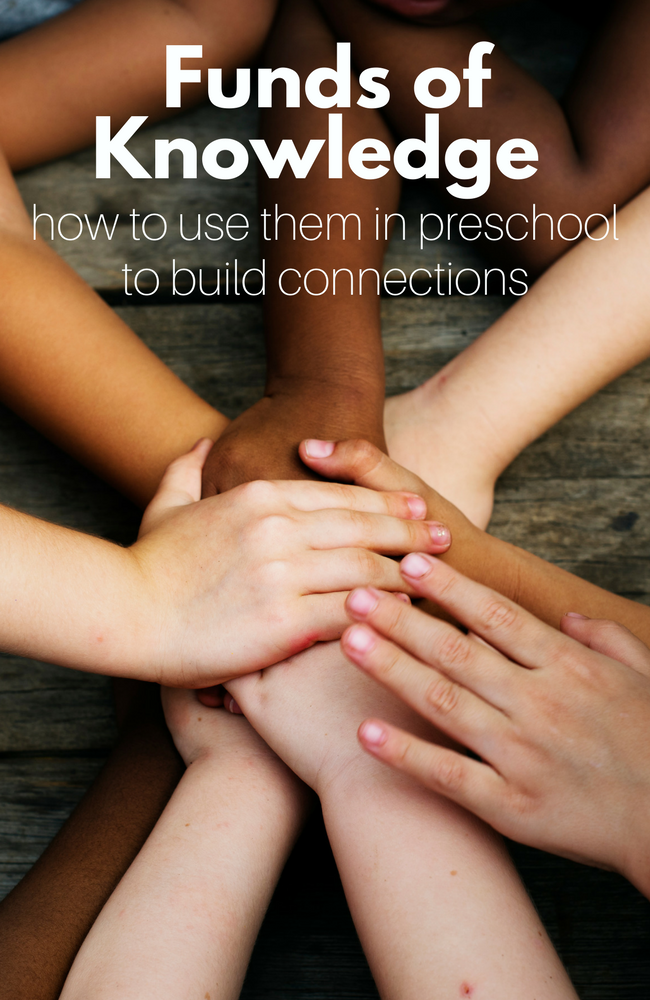
As teachers in general and be a lead teacher in our classroom, seeking out these Funds of Knowledge offer us a chance to see a more complex view of the families we serve and develop deeper relationships with them which can be harder to do when working cross-culturally but brings great benefits to both the students and our teaching practice.
Funds of Knowledge are collections of knowledge based in cultural practices that are a part of families’ inner culture, work experience, or their daily routine. It is the knowledge and expertise that students and their family members have because of their roles in their families, communities, and culture.
Funds of Knowledge can include learning quilting or spinning wool into yarn. It could be how to fix a car, how to care for a crying baby, or how to prepare a Seder. What makes using these Funds of Knowledge so powerful is that it is culturally relevant to students. It brings more diversity into your classroom for students that don’t relate culturally. It offers teachers a chance to become researchers of their students’ lives. This allows us to better connect with our students’ home cultures and ultimately to act as a bridge when needed. And it creates a deeper connection to learning materials and classroom activities for our students. As teachers, seeking out these Funds of Knowledge offer us a chance to see a more complex view of the families we serve and develop deeper relationships with them which can be harder to do when working cross-culturally but brings great benefits to both the students and our teaching practice.
Funds of knowledge can be everywhere in our classroom, we need to spend more time with children to teach and learn about that.
It’s our job to teach children positive lessons from their mistakes—and to make sure we don’t hold their mistakes against them.
We believe that the foundations for all healthy social-emotional development in the classroom include:
Teachers have to:
We do not use name-calling, belittling, comparing, shaming, threatening, accusing, or purposely humiliating a child as positive guidance techniques. NO CORPORAL PUNISHMENT will be used (spanking, slapping, hitting, jerking or tugging at children) to get a child to cooperate.
Corporal punishment is prohibited at all times by staff, parent/guardians, visitors etc. while on DLEC premises.
Conscious Discipline
Conscious Discipline is a comprehensive self-regulation program that integrates social-emotional learning, school culture, and discipline. It provides adults and children the skills to be disciplined enough to set and achieve goals, conscious enough to know we are off track, and connected enough to others so we are willing to persevere. Conscious Discipline is an adult-first model where the adult becomes the intervention strategy.
Second Step
Second Step is a social-emotional curriculum that utilizes puppets, description of pictures, and skill practice to help children develop skills of empathy, self-regulation, and problem-solving.
Handle with Care DLEC Education Staff uses Handle With Care, to ensure that children whose actions may be harmful to themselves and/or others are assisted in regaining self-control in a manner that is safe and respectful to the child. HWC’s young children’s program balances appropriate protection, containment and limit-setting with the child’s development of self-sufficiency and independence. If verbal intervention is not sufficient to contain the behavior, HWC also offers a physical program designed specifically for young children. HWC centerpiece proprietary child holding method is the “Modified PRT (Primary Restraint Technique) for Smaller Children™.” Handle With Care training and program is a federally approved vendor and is in full compliance with Children’s Healthcare Act of 2000;Health and Human Services Departmental Appeals Board rulings; Centers for Medicare and Medicaid Services regulations; Federal case law; Americans With Disabilities Act; No Child Left Behind Act; Section 504 of the Rehabilitation Act of 1973;Individuals with Disabilities Education Improvement Act, and, including various other federal and state laws. If HWC is used, the Education staff will work with parents to create a plan, which will outline the process for support the child in the classroom and at home, describe the situations in which Handle with Care may be implemented and provide HWC training for parents interested in being trained.
We also discuss and provide some Positive Guidance techniques at home for parents:
Parenting can be profoundly rewarding, but it can also be challenging. Every child and every family is different. Parenting styles and attitudes vary, and there is no one “right” way to parent. However, many parents have found that children respond well to a combination of:
How Do Environments Affect You?
There are certain places you like to go: maybe a favorite restaurant, a local park, a sporting arena or a good friend’s home. What about those places makes you feel welcome or secure? What makes you want to go back? Thinking about these places, you might remember the people around you, the color of a room, if there is sunlight, the smells and sounds, furniture and accessories or temperature.
Now consider places you don’t like to go: maybe the dentist’s office, the airport or a noisy restaurant. What makes these environments less pleasant for you? In some settings, we feel relaxed and comfortable. In other places, we might feel tense, overwhelmed and confused. The environment has a powerful effect on us. It influences how we feel, what we do and the ways we respond. Some of us dislike places where we feel we can’t control or predict our experiences. In some spaces, we may also feel we don’t belong or are not appreciated.
Just like adults, preschool-age children are affected by their environments, even if they cannot yet express these feelings in sophisticated ways. It’s our job to ensure classrooms and other learning spaces for children make them feel welcome, secure and ready to learn.
Designing Your Space to Meet Preschool Children’s Needs
Creating a supportive learning environment requires time, reflection (thinking) and planning. Whether children spend three or twelve hours a day in your program, the environment plays a major role in helping children develop and learn. Research suggests that a high-quality classroom environment can help close the achievement gap (Mashburn, 2008). That is, children who enter school less ready to learn are those that benefit the most from supportive classroom environments. Your supportive classroom can also be an important source of consistency for military children (a group that may experience a great deal of change in their daily lives). A supportive environment is:
Such supportive environments send children a variety of positive messages about their learning (Dodge et al., 2010), such as:
Environments not only affect how we feel and send messages about how to act, they can influence what we learn. The Reggio Emilia approach to early childhood education recognizes the tremendous impact of the environment by referring to it as the “third teacher” (with parents and teachers as children’s first and second teachers, respectively). The Reggio Emilia approach was developed by Loris Malaguzzi and named after an area in Italy. This approach states children are powerful learners and their interests should guide adults’ decisions surrounding learning, including how the environment is arranged and materials provided. The Reggio Emilia approach believes the learning environment plays a critical role, and that intentionality (thoughtful planning and action) on behalf of teachers in the design of spaces and the selection and arrangement of materials significantly influences children’s level of engagement and learning (Edwards, 2002). We will return to these ideas in future lessons in this course.
Places for Play and Learning: Interest Areas
When you walk into a retail or grocery store, how do you find what you need? If you are looking for grapes, you probably feel confident you can find them with other fresh fruits and vegetables. If you want a new pair of socks, you probably have a good idea about where to look. Obviously, some stores have better designs than others, but many retail establishments use simple design principles: objects with similar uses are stored near each other, and signs guide you. (Bright Horizon Newsletter)
Now think about a child in your classroom. How does he or she know where to find toys and materials or use the environment to make decisions?
There are many differences between retail establishments and classrooms, but organizing materials by their purpose makes sense in both environments. In stores, we might call these groups of similar items “departments.” In environments for young children, we use the terms “interest areas” or “learning centers” to describe spaces designed for certain purposes or that hold materials with similar uses.
When a child enters a well-designed interest area, they know:
As a preschool teacher, you design learning opportunities for children every day, and your classroom or outdoor environment sets the stage for most of these opportunities. Interest areas are key tools for learning in preschool learning environments. You can use children’s needs, interests and abilities to design your interest areas.
There are 10 common interest areas recommended for preschoolers in my Preschool classroom. These include:
Some important elements are found in every effective room design:
Denise Louie Education Center Vision:
Educating and empowering children and families to reach their full potential so they can advocate for themselves, our community and the world.
Denise Louie Education Center Mission:
Denise Louie Education Center promote school and life readiness by providing multi-cultural early learning services to children and families especially those who need our services the most. We respect and preserve each child and family’s individually, cultural heritage and home language. We will promote personal and social responsibility with integrity and love in an environment defined by social justice and peace.
Providing high quality early learning services and family support is critical to the success of our community. Children who do not have access to high quality early learning experiences are 25% more likely to drop out of school, 40% more likely to become a teen parent, 50% more likely to be placed in special education, and 70% more likely to be arrested for a violent crime.
Our children deserve better — and we cannot afford not to solve this problem. Investing in early learning now means we won’t be paying nearly so much down the road for “safety net” and correctional services. Beyond budgets, Denise Louie kids deserve a chance at a quality education and opportunity to be successful. Children from low-income families deserve to grow up in the same high-quality learning environments you would choose for your own children. A Rice University study found that a child from a high-income family will experience 30 million more words within the first four years of life than a child from a low-income family. Denise Louie helps close the “opportunity gap” so that kids can enter kindergarten ready to be successful and their families have the tools to support them.
Children Demographic:
Head Start is a federally funded community-based program for low-income, at-risk children (three to five years old) and families.
Denise Louie Education Center has four center site locations, one administrative office, and one Early Head Start office in Seattle, Washington. Additionally, we have 3 Play and Learn groups set up on a weekly basis throughout Seattle at the Columbia City, Rainier Beach and Lake City public libraries.
Our Head Start (HS) preschool program serves predominately immigrant and refugee families whose children are between ages three and five, and have an income under $24,600 for a family of four. Priority for enrollment into the program is given to children in foster care, homeless families, and children with special needs.
Embracing Diversity:
Asian 33%, Hispanic Latino 19%, Black or African American 24%, White 16%, Native Hawaiian or Pacific Islander 1%; Bi-multiracial 7% and American Indian or Alaska native 1%.
Denise Louie Education Center Vision:
Educating and empowering children and families to reach their full potential so they can advocate for themselves, our community and the world.
Denise Louie Education Center Mission:
Denise Louie Education Center promote school and life readiness by providing multi-cultural early learning services to children and families especially those who need our services the most. We respect and preserve each child and family’s individually, cultural heritage and home language. We will promote personal and social responsibility with integrity and love in an environment defined by social justice and peace.
Providing high quality early learning services and family support is critical to the success of our community. Children who do not have access to high quality early learning experiences are 25% more likely to drop out of school, 40% more likely to become a teen parent, 50% more likely to be placed in special education, and 70% more likely to be arrested for a violent crime.
Our children deserve better — and we cannot afford not to solve this problem. Investing in early learning now means we won’t be paying nearly so much down the road for “safety net” and correctional services. Beyond budgets, Denise Louie kids deserve a chance at a quality education and opportunity to be successful. Children from low-income families deserve to grow up in the same high-quality learning environments you would choose for your own children. A Rice University study found that a child from a high-income family will experience 30 million more words within the first four years of life than a child from a low-income family. Denise Louie helps close the “opportunity gap” so that kids can enter kindergarten ready to be successful and their families have the tools to support them.
Children Demographic:
Head Start is a federally funded community-based program for low-income, at-risk children (three to five years old) and families.
Denise Louie Education Center has four center site locations, one administrative office, and one Early Head Start office in Seattle, Washington. Additionally, we have 3 Play and Learn groups set up on a weekly basis throughout Seattle at the Columbia City, Rainier Beach and Lake City public libraries.
Our Head Start (HS) preschool program serves predominately immigrant and refugee families whose children are between ages three and five, and have an income under $24,600 for a family of four. Priority for enrollment into the program is given to children in foster care, homeless families, and children with special needs.
Embracing Diversity:
Asian 33%, Hispanic Latino 19%, Black or African American 24%, White 16%, Native Hawaiian or Pacific Islander 1%; Bi-multiracial 7% and American Indian or Alaska native 1%.
This is an example post, originally published as part of Blogging University. Enroll in one of our ten programs, and start your blog right.
You’re going to publish a post today. Don’t worry about how your blog looks. Don’t worry if you haven’t given it a name yet, or you’re feeling overwhelmed. Just click the “New Post” button, and tell us why you’re here.
Why do this?
The post can be short or long, a personal intro to your life or a bloggy mission statement, a manifesto for the future or a simple outline of your the types of things you hope to publish.
To help you get started, here are a few questions:
You’re not locked into any of this; one of the wonderful things about blogs is how they constantly evolve as we learn, grow, and interact with one another — but it’s good to know where and why you started, and articulating your goals may just give you a few other post ideas.
Can’t think how to get started? Just write the first thing that pops into your head. Anne Lamott, author of a book on writing we love, says that you need to give yourself permission to write a “crappy first draft”. Anne makes a great point — just start writing, and worry about editing it later.
When you’re ready to publish, give your post three to five tags that describe your blog’s focus — writing, photography, fiction, parenting, food, cars, movies, sports, whatever. These tags will help others who care about your topics find you in the Reader. Make sure one of the tags is “zerotohero,” so other new bloggers can find you, too.

 Thanh's Blog